 agent-swarm.dev
PR Review
Review a pull request for about $0.02. Two small models, Clairic and Jev, triage every hunk against what the PR claims, and one cheap coding agent reads only the batches they flag. One workflow and five scripts, ready to import.
Small models triage. The agent reads only what they flag.
This playbook reviews a GitHub pull request with the two System One models in Agent Swarm. Clairic reads the PR description and extracts what it claims. Jev tags every hunk of the diff, groups the hunks into category batches, and judges each batch against those claims and the repo's rules. A coding agent on a cheap model then reviews only the top flagged batches and proposes a patch for each finding. A clean PR never reaches the agent.
It is read-only and manual: it posts nothing to GitHub, and nothing fires on its own.
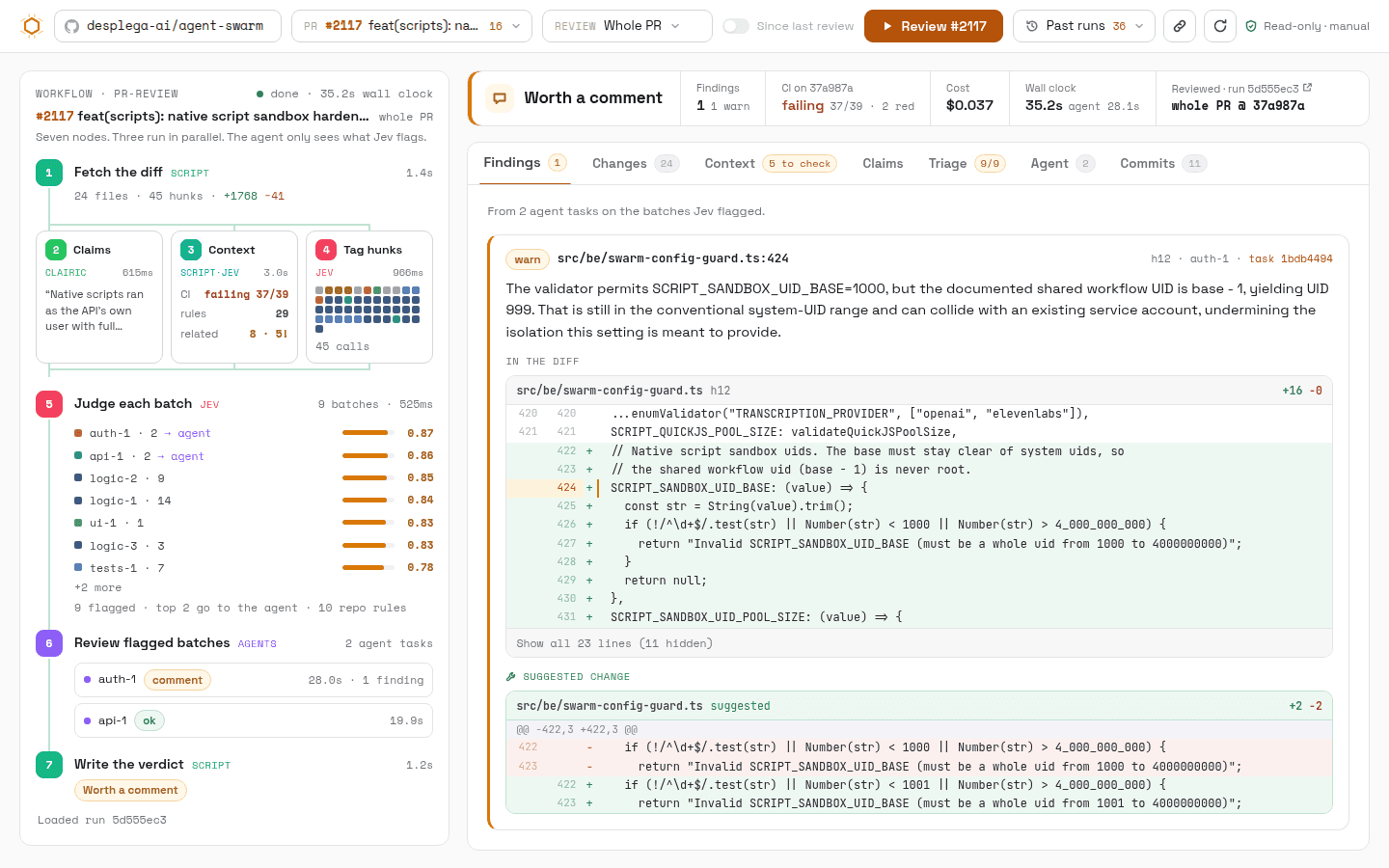
How it works
| Node | Type | What it does |
|---|---|---|
fetch | swarm-script (pr-review-fetch-diff) | Fetches the PR diff from GitHub and splits it into numbered hunks. A PR with more than 60 hunks falls back to one unit per file. |
claims | system-one-extraction (Clairic) | Extracts the PR's claims from its description: intent, stated risk, breaking changes, touched areas. |
context | swarm-script (pr-review-context) | Collects CI on the reviewed commit, repo rules (the repo's guidelines in the swarm and its CLAUDE.md), recent PRs on the same paths, and untouched files that import the changed modules. Jev ranks the related files. |
tag | swarm-script (pr-review-tag-units) | Jev tags each hunk with one category (tests, database, API, auth, deps/CI, UI, logic, docs), one parallel choice call per hunk. |
decide | swarm-script (pr-review-batches) | Groups the hunks into one batch per category, so the number of batches follows what the PR touches. Jev judges every batch in parallel: a general concern, drift from the PR's claims, overall risk, a category-specific question, and a repo-rule check. |
review | foreach of agent-task | One agent task per flagged batch, capped at the top 2 (maxAgentBatches). The agent sees only its batch's diff and the context, returns at most 3 findings, and proposes a minimal patch for each. |
report | swarm-script (pr-review-report) | Writes the verdict, findings, files, CI and the cost of each model. |
The verdict is one of clean (Jev flagged nothing), flags_cleared_by_agent, comment or request_changes.
claims, context and tag run in parallel. The workflow sets onNodeFailure: "continue", so a failed context lookup does not stop the review.
What you import
Every file lives next to this page on the docs site.
| File | What it is |
|---|---|
pr-review.workflow.json | The workflow: 7 nodes, manual trigger with {repo, pr} |
pr-review-fetch-diff.script.ts | PR, one commit, or a commit range to numbered hunks plus Clairic's input |
pr-review-context.script.ts | CI, repo rules, related files and recent PRs |
pr-review-tag-units.script.ts | Jev tags each hunk with a category |
pr-review-batches.script.ts | Category batches, Jev judges each one |
pr-review-report.script.ts | The per-PR report |
github-list-open-prs.script.ts | Optional, for a review page: lists a repo's open PRs |
pr-review-demo-info.script.ts | Optional, for a review page: review cost per PR, commits, CI and past reviews per commit |
Prerequisites
- Agent Swarm with a Lead. Install as the Lead: global scripts can only be saved by a lead.
- A reviewer worker. One online worker that will run the review tasks. The export pins
model: "gpt-5.6-luna", a Codex model, so the original runs on a Codex worker. On another harness, setmodelto a cheap model that harness serves, or replace it with"modelTier": "smol". - Clairic (the
claimsnode). It runs on Cloudflare Workers AI and needs theCLOUDFLARE_ACCOUNT_IDglobal config value and theCLOUDFLARE_API_TOKENglobal secret (CLOUDFLARE_API_KEYalso works). Without them, the run fails before any node executes. - Jev (the
tag,contextanddecidescripts). The scripts callctx.swarm.systemOne_decidewithout a provider, so the calls go to the host in theSYSTEM_ONE_DEFAULT_PROVIDERglobal config value,typesafewhen unset. Fortypesafe, set theTYPESAFE_API_KEYsecret. For OpenRouter, setSYSTEM_ONE_DEFAULT_PROVIDER=openrouterandOPENROUTER_API_KEY. The thresholds inpr-review-batchesare tuned on Jev. If you point the default at another host (for examplecloudflare, which serves Clef), re-tune them. - GitHub access. A
GITHUB_TOKENglobal secret that can read the repo's pull requests, contents, commit statuses and checks, and use code search. The scripts never see the token: they send a[REDACTED:GITHUB_TOKEN]placeholder, and the default credential binding swaps in the real value forapi.github.comonly. The workers do not need repo access, because the agent reviews the diff it is given and never clones.
See SystemOne Decision and SystemOne Extraction for every provider, key and model.
Install
export SWARM_URL=https://api.example.com   # your agent-swarm API
export API_KEY=...                         # swarm API key
export LEAD_ID=...                         # your Lead's agent id
H=(-H "Authorization: Bearer $API_KEY" -H "X-Agent-ID: $LEAD_ID" -H "Content-Type: application/json")
DOCS=https://docs.agent-swarm.dev/playbooks/pr-review
1. Keys. Skip any you already have. Use isSecret: false for CLOUDFLARE_ACCOUNT_ID.
put() { curl -s "${H[@]}" -X PUT $SWARM_URL/api/config \
  -d "{\"scope\":\"global\",\"key\":\"$1\",\"value\":\"$2\",\"isSecret\":$3}"; }
put CLOUDFLARE_ACCOUNT_ID "$CF_ACCOUNT_ID" false
put CLOUDFLARE_API_TOKEN  "$CF_API_TOKEN"  true
put TYPESAFE_API_KEY      "$TYPESAFE_KEY"  true
put GITHUB_TOKEN          "$GH_TOKEN"      true
2. The scripts. The workflow's swarm-script nodes call them by name.
for s in pr-review-fetch-diff pr-review-context pr-review-tag-units pr-review-batches pr-review-report; do
  curl -s $DOCS/$s.script.ts \
    | jq -Rs --arg n "$s" '{name: $n, scope: "global", source: .}' \
    | curl -s "${H[@]}" -X POST $SWARM_URL/api/scripts/upsert --data-binary @-
done
3. The workflow. Fill in the reviewer's agent id. GET /api/agents lists agents with their ids and harness.
REVIEWER_ID=$(curl -s "${H[@]}" $SWARM_URL/api/agents | jq -r '.agents[] | select(.name=="<your reviewer>") | .id')

WORKFLOW_ID=$(curl -s $DOCS/pr-review.workflow.json \
  | sed "s|<REVIEWER_AGENT_ID>|$REVIEWER_ID|" \
  | curl -s "${H[@]}" -X POST $SWARM_URL/api/workflows --data-binary @- | jq -r .id)
Leave agentId out of the review node's config to let the swarm route each review task to any worker instead.
Run a review
Trigger it by hand with the repo and the PR number:
RUN_ID=$(curl -s "${H[@]}" -X POST $SWARM_URL/api/workflows/$WORKFLOW_ID/trigger \
  -d '{"repo":"acme/api","pr":123}' | jq -r .runId)
Add "sha" to review one commit, or "sha" and "base" to review only what changed between two commits. A re-review after a new push then costs only the size of that push. You can also use trigger-workflow from an agent, or the dashboard.
The run takes about 30 seconds. Read the verdict from the report step:
curl -s "${H[@]}" $SWARM_URL/api/workflow-runs/$RUN_ID \
  | jq '.steps[] | select(.nodeId=="report") | .output.result | {verdict, summary, cost, findings: [.agentReviews[].review]}'
Each entry in agentReviews is one agent task: its batch, its own verdict (ok, comment or block) and its findings with file, line, severity, comment and patch.
Results
We ran it on 14 open PRs in desplega-ai/agent-swarm:
| Median run | 30 s per PR |
| Total cost | $0.26 for 14 PRs, about $0.02 per PR |
| Jev | 495 calls, $0.024 in total |
| Agent | 24 review tasks, $0.24 in total, about 16 s each |
| Verdicts | 2 clean, 4 flags cleared by the agent, 4 worth a comment, 4 request changes |
Two of those runs:
- #2117, a 24-file sandbox hardening PR: 45 hunks, 9 batches, the top 2 sent to the agent. Verdict: worth a comment, $0.037, 35 s. The agent found that the new uid bound lets the shared workflow uid land at 999, inside the system uid range, and proposed a two-line patch (the screenshot at the top).
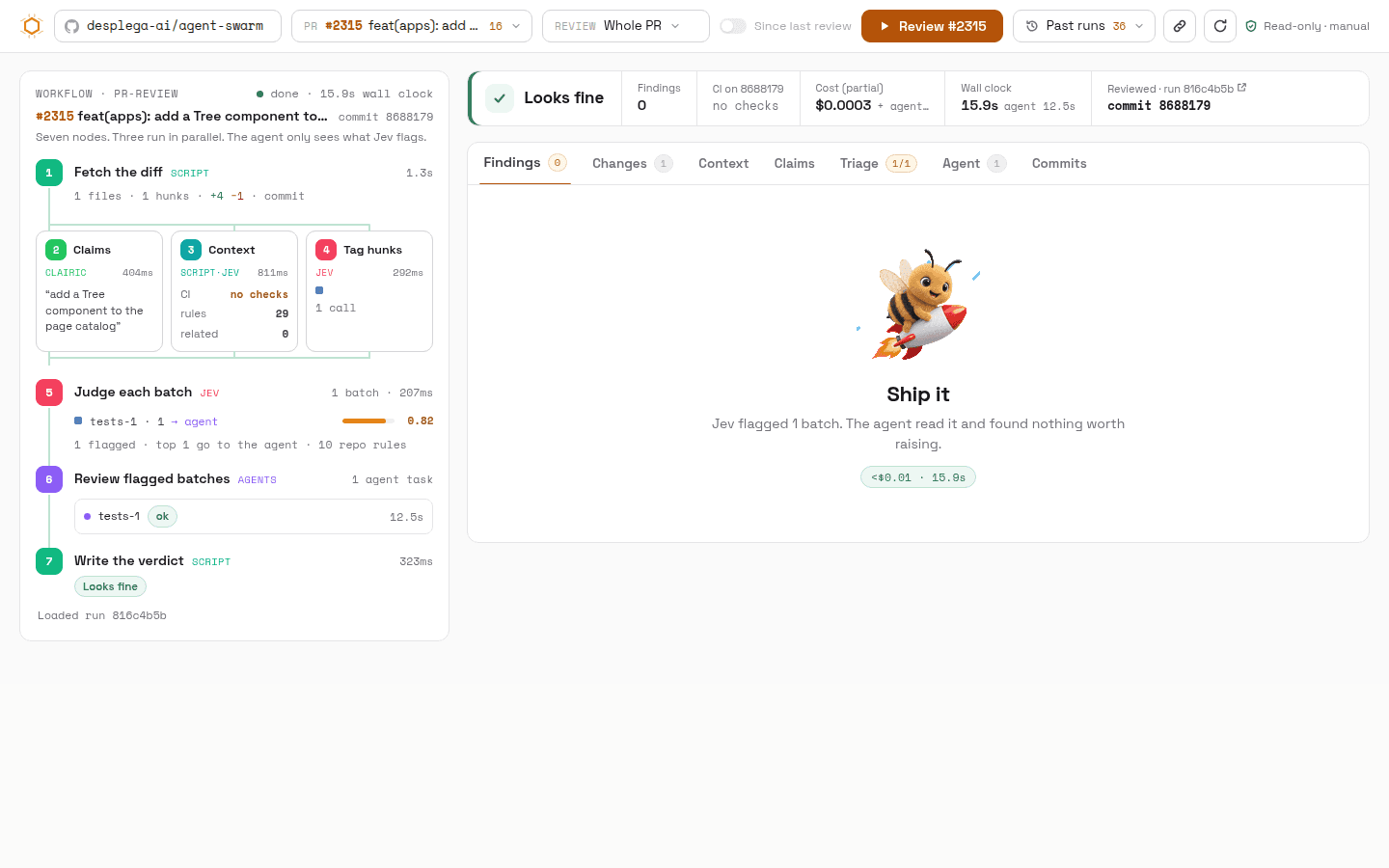
- #2315, a one-file commit: one batch, the agent found nothing. Verdict: looks fine, under $0.01, 16 s.
Optional: a review page
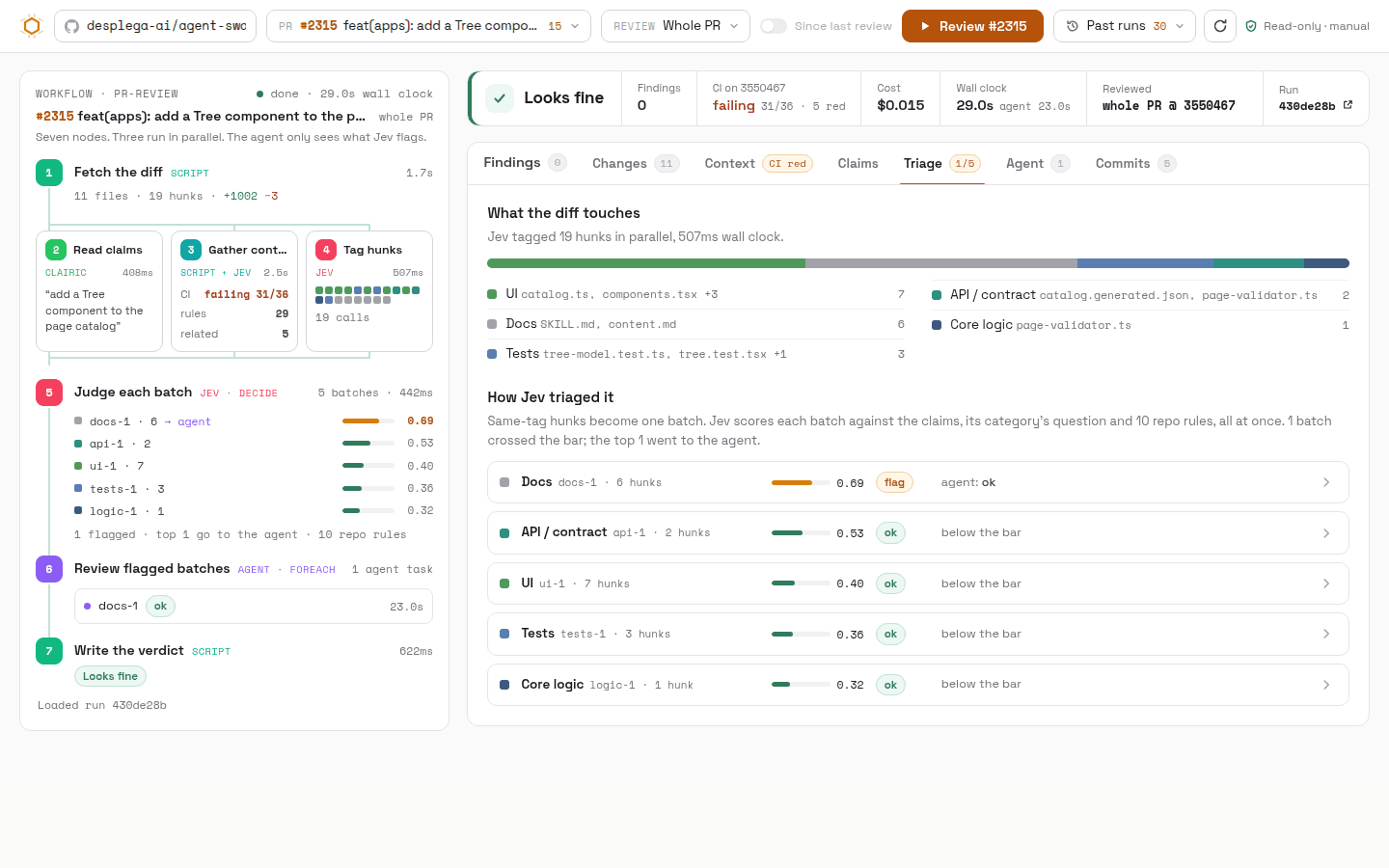
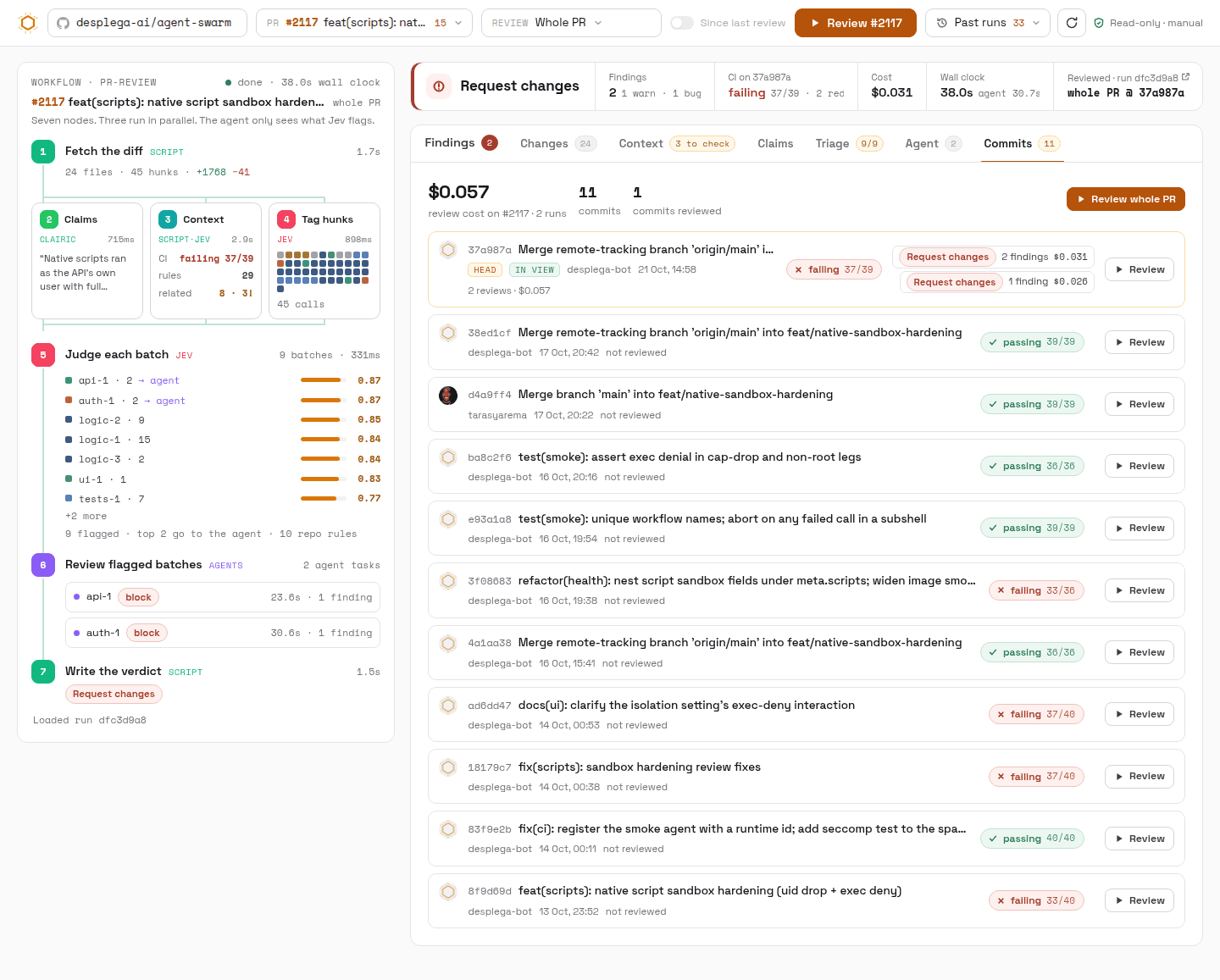
We put the workflow behind a swarm Page, an HTML page the swarm hosts for signed-in users: pick a repo and a PR, review the whole PR or only what changed since the last review, and watch the run as a live graph. Its tabs show the findings with suggested patches, the changed files, the context, the claims, Jev's score per batch, the agent's progress updates, and the commits with CI and review cost per commit.
The page reads its data from two extra scripts. Install them like the others, with your workflow id filled into pr-review-demo-info:
curl -s $DOCS/github-list-open-prs.script.ts \
  | jq -Rs '{name: "github-list-open-prs", scope: "global", source: .}' \
  | curl -s "${H[@]}" -X POST $SWARM_URL/api/scripts/upsert --data-binary @-
curl -s $DOCS/pr-review-demo-info.script.ts | sed "s|<PR_REVIEW_WORKFLOW_ID>|$WORKFLOW_ID|" \
  | jq -Rs '{name: "pr-review-demo-info", scope: "global", source: .}' \
  | curl -s "${H[@]}" -X POST $SWARM_URL/api/scripts/upsert --data-binary @-
Then ask your Lead to build the page with the pages skill: a repo and PR picker from github-list-open-prs, a Review button that triggers the workflow, the run's steps polled from GET /api/workflow-runs/<id>, and the cost and commit views from pr-review-demo-info.
Tuning
maxAgentBatcheson thedecidenode caps agent spend per PR (2 by default).pr-review-batchesalso takesthreshold,concernThresholdanddriftThreshold(0.5, 0.6 and 0.6). Raise them to send fewer batches to the agent.- Repo rules come from the repo's guidelines in the swarm and its
CLAUDE.md. Better rules give Jev and the agent better checks. pr-review-contextadds hotspots and temporal coupling when acode-maatKV entry<repo-name>:review-indexexists. Without it, that part is skipped.
Limits
- The agent sees only its batch. A reference into another batch can look like a bug.
- Findings are model output and unverified. On big PRs Jev flags most batches; the 2-batch cap bounds the agent's spend, so the lower-scored batches go unread.
- Manual only. Nothing is posted back to GitHub, and no trigger fires on new PRs. Add a GitHub webhook trigger and a posting step if you want that.
- CI is reported, not judged. The agent is told never to raise red CI as a finding; the report shows CI separately.
Open Oncall
An alert lands in Slack, the swarm finds the root cause, a person approves the fix in one click, and the swarm opens the PR. If one AI provider is down, the step reroutes to another. One workflow, one failover sub-workflow, one script and an app, ready to import.
Hot Patterns
Five patterns that recur across every playbook — litmus tests, drain loops, HITL gates, per-customer working directories, and no-op workflows. These are the recipes that compound, regardless of which use case you're building.