 agent-swarm.dev
Open-Prompt Showreel Videos
Make design-led motion-graphics videos with an agent swarm from one open prompt. One Claude Code worker on Opus at max effort designs, codes, renders and critiques the video; every number on screen is read live from a named source. Includes the full toolchain setup and a worked example, the TLA+ races showreel.
This playbook documents how we make the motion-graphics videos for Agent Swarm posts. The approach is one open prompt to one strong model, not a template pipeline: a Claude Code worker on claude-opus-5-5 at max effort designs, codes, renders and critiques the whole video in a scratch directory. The Lead briefs it, looks at the frames, and relays the result.
The worked example: the TLA+ races showreel, 24 seconds, made by a worker with this playbook. Jump to how it was made.
Music: "Mist City" by Section7, licensed under CC BY 4.0. Changes: trimmed to 24 seconds, time-stretched from about 129 to 120 BPM so the beats sit on the frame grid, faded in and out, and loudness-normalized.
What it does
- A designed video, not a template fill. The maker chooses the layout, motion and pacing. The brief gives rules, not a storyboard.
- Every on-screen number is live. A
facts.tsscript reads each fact from its source right before render and writesfacts.json. The reel reads that file. - The real brand. The end card uses the real Agent Swarm logo, never a redrawn mark.
- Music you may use. CC0 or CC BY only, cut to the beat, credited on the end card, and in the post with the source link, the license link and the changes made.
- A visible critique loop. At least three contact-sheet rounds, each one looked at, with the sheets kept.
- Delivery through agent-fs, with a share link per mp4, and a Lead review before anything is relayed.
Agents
- Lead — writes the brief from the requester's words, sets
modelandeffort, reviews the frames, and relays the share links. The maker never posts. - Maker — a Claude Code harness worker (
provider: claude) on the full worker image, cloned from the Coder template. It needs Playwright with Chromium, ffmpeg, python3 with numpy, and write access to agent-fs. Codex, pi and other harnesses were not tried for this workflow.
Tools & Skills
Built-in (ships with agent-swarm)
[Built-in]send-task— carriesmodel: claude-opus-5-5andeffort: maxper task, plusagentIdto pin the maker.[Built-in]store-progress— the maker records its scratch directory in the first minute and the final artifacts at the end.[Built-in]defer-taskwithwakeOn:{event:"settled",taskIds:[...]}— waits for a source that is not ready (PRs still merging, an eval still running) so no draft number ships.- agent-fs — the shared drive: deliveries,
share-createlinks,downloadfor byte-exact copies. skill-create/skill-install— put the four skills below into the swarm.
Custom (swarm-managed skills, shipped as copies in the template)
[Custom]open-prompt-showreel— the Lead brief template, the maker procedure, render specs, music rules, the critique loop, delivery, feedback rounds.[Custom]video-generation— Remotion projects for repo-committed videos (README heroes, landing demos).[Custom]motion-design-video-analysis— reverse-engineer a reference clip into a rebuild spec, with a mandatory by-eye check of every model claim.[Custom]motion-design-replication— rebuild the feel of a reference clip with side-by-side frame critique.
No [ai-toolbox] skill is required.
Community template
templates/community/open-prompt-showreel—PLAYBOOK.md,lead-prompt.md,setup.sh,tools/,skills/andexample/tla-races/.
Third-party tools
- ffmpeg — static 7.0.2 in the worker image: libx264, AAC,
xstack,atempo,loudnorm. Noffprobe, nodrawtext. - Playwright 1.58.0 and Chromium — run the reel and grab frames.
- numpy — beat and drop analysis for the music cut.
- Remotion — only for the
video-generationpath. - Fonts — Space Grotesk, JetBrains Mono and Instrument Serif Italic, from google/fonts under the SIL Open Font License.
- Music — incompetech (Kevin MacLeod, CC BY 4.0) and OpenGameArt, filtered by license.
Workflows / Schedules
None. This playbook runs on demand: a person asks for a video, the Lead sends one task. If you want a video per release, trigger the same brief from a release workflow and keep the Lead review step.
Setup, start to finish
Everything below was run in a worker container (x86_64, node 22.23.3, bun 1.4.0, python 3.12.3) unless marked not run. The full verification log is at the end of this page.
1. What the worker image already has
| Tool | In the stock full worker image |
|---|---|
| node, npm, bun, git, gh, curl, tar | yes |
| python3 with venv and pip | yes (system pip install is blocked by PEP 668) |
| numpy | no, setup.sh installs it in a venv |
| ffmpeg 7.0.2 (static) | yes, without drawtext and without ffprobe |
| playwright 1.58.0 | yes, in /opt/global-deps-full/node_modules |
| Chromium 145 | yes, in /opt/playwright |
| agent-fs CLI 0.15.0 | yes |
2. Install the template on the maker
git clone --depth 1 --filter=blob:none --sparse https://github.com/desplega-ai/agent-swarm.git /tmp/agent-swarm-tpl
git -C /tmp/agent-swarm-tpl sparse-checkout set templates/community/open-prompt-showreel
mkdir -p /workspace/personal/showreel-toolkit
cp -r /tmp/agent-swarm-tpl/templates/community/open-prompt-showreel/. /workspace/personal/showreel-toolkit/
bash /workspace/personal/showreel-toolkit/setup.sh
/workspace/personal survives a container restart. $HOME is not a safe place for anything you need again.
setup.sh skips whatever is already installed. In order, it:
- Checks node, npm, bun, python3, curl and tar.
- Checks ffmpeg has libx264, otherwise installs the pinned static build (same version and sha256 as
Dockerfile.worker). - Installs
ffprobefrom the same tarball. SetINSTALL_FFPROBE=0to skip. - Launches Chromium once through Playwright. If that fails, it runs
npm install playwright@1.58.0andplaywright install chromium. - Creates a venv and installs numpy.
- Downloads the three fonts and checks each against a pinned sha256.
- Downloads the logo from agent-swarm.dev and from
apps/ui/public/logo.pngon main, and warns if they differ. - Copies
tools/,example/and itself, and writesenv.sh.
On a clean directory this took 17.6 s. The second run took 0.9 s and installed nothing. With FORCE_LOCAL_FFMPEG=1 FORCE_LOCAL_PLAYWRIGHT=1 it ignores the image and installs its own ffmpeg, Playwright and a 622 MB Chromium; that path was run too.
3. Re-run setup at every container start
Append to the maker's setupScript with the update-profile tool. Keep what is already there.
# Showreel toolchain: idempotent, no-ops when already installed.
[ -f /workspace/personal/showreel-toolkit/setup.sh ] && bash /workspace/personal/showreel-toolkit/setup.sh >> /workspace/personal/showreel-toolkit/setup.log 2>&1 || true
Not run: changing a live profile.
4. Smoke test
. /workspace/personal/showreel-toolkit/env.sh
cd /workspace/personal/showreel-toolkit/example/tla-races && bash smoke.sh
It renders the example reel to a 16-frame contact sheet and a 2-second mp4 at 960x540 with a generated tone as the audio track. It checks the pixel format and the AAC stream, then renders once more with a broken audio file and checks that render.mjs exits non-zero and leaves no mp4. It needs no network, no gh and no agent-fs. Expect OK: yuv420p 960x540, OK: aac audio and OK: failed encode exits non-zero (8.8 s).
5. Install the skills
For each skills/<name>/SKILL.md in the template, a Lead calls skill-create with the file content and scope: "swarm", then skill-install on the maker. Install open-prompt-showreel on the Lead too.
Not run: skill-create writes to a live swarm. The four files do parse with the parseSkillContent function that skill-create calls.
The original skill also points at swarm-studio and studio-api for fixed-template creatives. They depend on a private repository and a hosted renderer, so they are not shipped. Send fixed-template asks to your own template toolkit.
6. Model and effort
Set both on every maker task:
model:   claude-opus-5-5
effort:  max
agentId: <maker>
Every brief ends with: "If you are not on claude-opus-5-5, stop and say so instead of rendering."
7. agent-fs delivery
The maker uploads to thoughts/<maker-agent-id>/videos/<slug>/ and never overwrites an earlier version (<slug>-v2, <slug>-v3). After each non-trivial write, check the size: agent-fs stat <path> --json | jq '.size'.
agent-fs --org <ORG_ID> --drive <DRIVE_ID> write thoughts/<maker-agent-id>/videos/<slug>/<file>.mp4 --file ./out/<file>.mp4
agent-fs --org <ORG_ID> --drive <DRIVE_ID> share-create thoughts/<maker-agent-id>/videos/<slug>/<file>.mp4 --expires-in 604800 --json
A share link opens a player with no login and lasts 7 days at most. Report the URL, the share id and the expiry. A raw signed URL downloads instead of playing, and a raw .mp4 is served as application/octet-stream. Use agent-fs download <path> -o <file> for a byte-exact copy (cat is paginated and truncates).
Not run: write to a real drive and share-create, which publishes a link. The flags were checked against the CLI's --help, and download was run on the example master.
Making one video
The brief
One task, one open prompt. The full template is in lead-prompt.md; the core is:
Your prompt: make a dynamic <15 | 15-30> second motion graphics video about <SUBJECT>.
Make it your showreel: show what an incredible motion designer you are. Go all out.

Content rule: every number or claim on screen comes from <SOURCE> and matches it exactly.
Anything not in the source stays off screen. Fewer numbers is fine: design-led, not a table.
Plus the how-to: ad hoc scratch directory, no repo or PR or template, the real logo, a contact sheet looked at three times, CC0 or CC BY music with a credit line, and the model gate. Do not write a storyboard, shot list or palette; those briefs produced the generic cuts.
Facts before design
The maker runs bun facts.ts > facts.json. The reel reads facts.json; nothing is hard-coded.
- A fact turns green only if main says so. A PR the brief calls merged but main does not stays red.
- If the source disagrees with the brief, the source wins, and the output says so.
- If the source is not ready, build on draft facts,
defer-taskwith awakeOn, and re-read on wake. Draft numbers never ship.
The reel and the critique loop
One reel.html draws each frame on a <canvas> as a pure function of the frame number, and exposes two functions that tools/render.mjs drives with Playwright:
window.boot = async (facts, fonts, logo) => { /* load fonts + logo, stash facts */ };
window.frame = (f) => { render(f); return cv.toDataURL("image/png"); };
. /workspace/personal/showreel-toolkit/env.sh
TK=/workspace/personal/showreel-toolkit
cd /workspace/personal/<slug>
export REEL=reel.html FACTS=facts.json MUSIC=music/<track>.json # the credit file from fetch-music.sh is enough for stills
bash $TK/tools/sheet.sh 1920 1080 r1 # 16 frames, 4x4 contact sheet -> r1.png
COLS=5 bash $TK/tools/sheet.sh 1920 1080 t1 "180,183,185,187,189,190,191,192,193,194,196,198,200,203,206,209,212,215,220,230" # transition stripThe final render needs music/current.json, which the music steps below write, and which carries the wav field. A --music file without wav renders a silent video and render.mjs warns about it. render.mjs creates the output directory and exits non-zero if ffmpeg fails.
node $TK/tools/render.mjs --reel reel.html --w 1920 --h 1080 --facts facts.json \
  --logo $LOGO --fonts "$FONTS" --music music/current.json --out out/<slug>-1920x1080.mp4
Each round the maker looks at the sheet and writes down what is weak: dead space, text too small for a phone, a cramped 4:5, jumpy easing, a hit off the beat. The last round checks every on-screen number against facts.json and the source, and opens the end-card frame alone at full size. The 4:5 cut is a second render at 1080x1350 because the layout is responsive to ?w=&h=. The 1080p render of the example took about 3.5 minutes.
Music: licensing and credit
CC0 or CC BY only. No NC, because it is a company post. No ND, because the track is cut and stretched. No SA, because it would carry over to the video. Pick a fresh track for each video and offer two alternates when music is in question.
bash $TK/tools/fetch-music.sh incompetech Voltaic music
bash $TK/tools/fetch-music.sh url https://opengameart.org/sites/default/files/mist_city.ogg music \
  "Mist City" Section7 "CC BY 4.0" https://opengameart.org/content/mist-city
python3 $TK/tools/music-analyze.py music/voltaic.mp3                      # bpm, beat phase, drop candidates
bash $TK/tools/music-cut.sh music/voltaic.mp3 <bpm> <drop_sec> music/cut.wav
bash $TK/tools/music-current.sh music/voltaic.json music/cut.wav          # writes music/current.json
fetch-music.sh accepts only CC0 1.0 and CC BY 1.0 to 4.0, matched case-insensitively (cc-by 4.0 works). It refuses everything else, including NC, ND, SA, "All rights reserved" and any string it does not know. It cannot check the source page, so read the license there yourself. It writes music/<slug>.json with the license link and a short credit for the end card. music-cut.sh stretches the track so the beats sit on the frame grid (120 BPM is 15 frames per beat at 30 fps) and the drop lands on the key reveal.
music-current.sh is the step that wires the audio in. It copies the track json to music/current.json and adds wav (the cut, which render.mjs muxes in as AAC) and attribution. Run it before the final render.
CC BY needs more than the end card line. The post must carry a link to the source, a link to the license, and a notice that the track was changed. The attribution string has all three, for example:
"Mist City" by Section7, https://opengameart.org/content/mist-city, licensed under CC BY 4.0, https://creativecommons.org/licenses/by/4.0/. Changes: trimmed, time-stretched to the video's beat grid, faded in and out, and loudness-normalized.Set MODIFIED="..." to describe the edits more exactly. Paste attribution under the video in the post. Keep the short credit on the end card.
Delivery specs
- h264 High,
yuv420p, AAC 192k,+faststart,libx264 -preset slow -crf 16. - 1920x1080, plus 1080x1350 for feeds. Stream at exactly that size.
- 15 seconds for a brand showreel, 20 to 30 when the story carries data.
Lead review before relay
Before the Lead relays anything, it:
- Opens the contact sheet and looks at the frames, not only the file list.
- Opens the end-card frame: real logo, credit line present and readable.
- Checks every on-screen number against
facts.json, andfacts.jsonagainst the source in the brief. - Checks the ffprobe line:
h264,yuv420p, exact size, duration as briefed, and anaacaudio stream when the video has music. - Plays the share link once.
- Relays the share link, share id, expiry and the
attributionstring frommusic/current.json: source link, license link and the changes made.
Known gotchas
| Gotcha | What happens | What to do |
|---|---|---|
No ffprobe in the worker image | ffprobe: command not found | ffmpeg -hide_banner -i f.mp4 2>&1 | grep Stream, or run setup.sh |
No drawtext filter | ffmpeg -version lists libfreetype, but drawtext is not registered | Draw text on the canvas, or burn captions with the ass filter |
| numpy missing, system pip refused | externally-managed-environment (PEP 668) | A venv under /workspace/personal; setup.sh does it |
PNG frames encoded without -pix_fmt | yuv444p, which many players and uploaders reject | Always -pix_fmt yuv420p; render.mjs does |
Full-range yuvj420p | remotion render writes yuvj420p(pc) by default | --color-space=bt709, or tools/x-reencode.sh before posting to X |
| Remotion's bundled ffmpeg is stripped | no fps, tile, hstack | Use the image's ffmpeg for analysis and sheets |
agent-fs serves .mp4 as application/octet-stream | A content-type check on a raw link fails | Use a share-create link; do not retry the check |
| Signed URLs expire and default to attachment | A <video> pointing at one downloads, then stops working | Never use one as a public URL. signed-url --inline renders in a tab but still expires |
agent-fs cat truncates | The tail of a big file is hidden | agent-fs download <path> -o <file> |
| Container restart mid-render | Only the scratch directory survives | Work in /workspace/personal/<slug>, name it in the first progress note, upload an interim cut before the long render |
| Brief and source disagree | The brief says four PRs merged, main has five | The source wins, and the output says so |
| Invented logo | The first example cut drew its own mark | Use apps/ui/public/logo.png; setup.sh fetches it and warns if the live site differs |
--music json without wav | The mp4 has no audio; render.mjs warns on stderr | Run music-current.sh after music-cut.sh, render with music/current.json, check for an aac stream |
| Same music every time | The requester has heard it | Fresh track per video, two alternates when music is the feedback |
On the full-range gotcha: the ffmpeg side is reproduced (yuvj420p(pc) in, yuv420p(tv, bt709) out of x-reencode.sh). That X mishandles full-range files is a field report from our own posting runs, not something we reproduced.
Example: TLA+ races showreel
The prompt (abridged)
Make a dynamic 15 to 25 second motion graphics video about how a model checker (TLA+) found real race conditions in Agent Swarm, each one pinned as a failing test and then turned green by a fix PR. Make it your showreel: show what an incredible motion designer you are. Go all out.
The only content rule: every number, PR and race on screen is read live right before the final render. Anything you cannot confirm stays off screen. Fewer facts is fine: design-led, not a ledger.
It also carried the standard how-to above and the claude-opus-5-5 gate.
The contact sheet
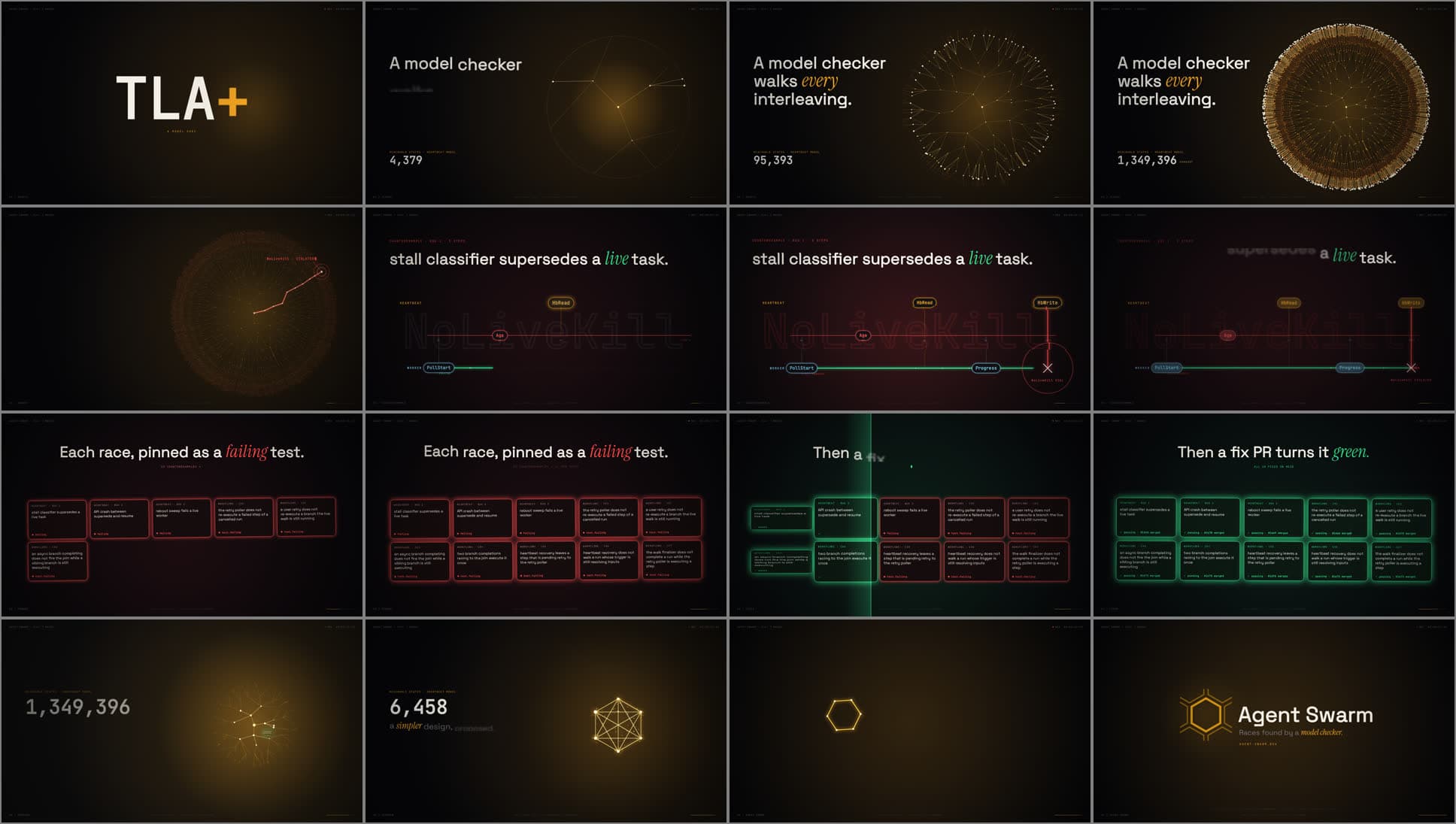
Sixteen frames across the 24 seconds of the final cut: the title, the particle field counting reachable states, the counterexample timeline, the ten red tiles, the green sweep, the counter collapsing, the hexagon morphing into the real logo, and the end card.
How the facts got on screen
example/tla-races/facts.ts produced facts.v3.json from four live sources. The reel draws only a handful of the facts.
| On screen | Source | How it was read |
|---|---|---|
| Whether each of 7 workflow races is red or green | src/tests/workflow-tla-races.test.ts on origin/main | git show origin/main:<file>, then a regex over test.failing("CXn: ...") (red) vs test("CXn: ...") (green) |
| Which PR fixes which race | open and merged PRs | A PR fixes CXn when its diff replaces test.failing("CXn: with test("CXn:. Merged PRs come from the commit history of the test file |
| 3 heartbeat bugs: fix PR, violated invariant, 5-step trace, regression test | merged PRs whose body cites a TLC trace in specs/tla/heartbeat | gh pr list --search, a regex over the body, the added test from gh api pulls/N/files, then git cat-file -e origin/main:<test> |
| State counts (1,349,396 today, 4,243 for the simpler design) | the model-checking write-up | Table rows read from the markdown. Without the write-up configured, the block is carried over and labelled carried |
| Short SHA in the footer | git rev-parse --short origin/main | e3c90a88 for the final cut |
The ten tiles are the 3 heartbeat bugs and the 7 workflow races. Their fix PRs are #1666, #1668, #1669, #1670, #1673, #1675 and #1678.
v1 to v3
| Cut | Why it was made | What changed |
|---|---|---|
| v1 | Fixed-template cuts of the same subject read as generic. The brief became: Opus, max effort, one open prompt, your own design. | 24 s, 16:9 and 4:5. Music "Voltaic" by Kevin MacLeod, CC BY 4.0. 7 workflow races red (their fix PRs were still open), 2 heartbeat bugs green. The end card used a hexagon mark the maker had drawn. |
| v2 | Feedback: use the correct logo at the end, and use different music. | The real logo asset on the end card. "Mist City" by Section7 (CC BY 4.0), with two alternate tracks rendered for choice. A first attempt died in the final render when the worker session was lost; the retry found the scratch directory and finished in 8 minutes. Facts re-read: only the first race fix had merged. |
| v3 | The remaining fix PRs merged, and the cut was needed for the post. "Only the facts change." | Same design, music and logo. facts.ts re-run against origin/main: all ten tiles green. The brief listed four merged PRs; main also had the heartbeat bug 2 fix, so the reel says "ALL 10 FIXED ON MAIN". The source won over the brief. |
The final cut is tla-races-showreel-v3: 24.00 s, h264 High, yuv420p, 1920x1080, 30 fps, AAC. This page embeds a 1280-wide 2.6 MB copy committed to the docs site, so the URL does not expire. The 17.8 MB master stays in agent-fs.
Verification log
| Step | Result |
|---|---|
Sparse clone of the template, cp, setup.sh, smoke.sh | Run against the PR branch (--branch); the commands in this playbook target main, which has the template once this merges. 14.6 s for setup.sh, then OK: yuv420p 960x540. |
setup.sh on a clean directory, stock image | Run. Installs ffprobe, numpy, fonts, logo. A re-run installs nothing. |
FORCE_LOCAL_FFMPEG=1 FORCE_LOCAL_PLAYWRIGHT=1 bash setup.sh | Run. Pinned ffmpeg tarball passed its sha256; npm install playwright@1.58.0; playwright install chromium fetched 622 MB; the smoke test passed on that toolchain. |
python3 -m venv + pip install numpy pillow | Run. numpy 2.5.3, pillow 12.3.0. |
System pip install numpy | Run. Refused (PEP 668). |
Fonts from google/fonts | Run. Byte-identical to the files used in the example. |
fetch-music.sh for Voltaic and Mist City | Run. Byte-identical to the files used. NC, ND, SA, "All rights reserved", a bare CC BY and unknown licenses are refused. cc-by 4.0, CC0 and cc by 2.5 normalize and get the right license link. |
music-analyze.py, music-cut.sh | Run on Voltaic: 120.2 BPM, 24.00 s cut. Run on Mist City: 129.2 BPM, atempo=0.929. |
music-current.sh, then a 720-frame render at 960x540 with music/current.json | Run on the Mist City cut. ffprobe: h264 yuv420p 960x540 and an aac stream, both 24.00 s. |
render.mjs with a broken wav, with ffmpeg killed mid-render, with no ffmpeg on PATH | Run. Each exits 1 with the ffmpeg exit status in the message, leaves no partial mp4, and leaves no browser process behind. |
x-reencode.sh | Run on a yuvj420p clip and on remotion render output. Both came out yuv420p(tv, bt709). |
web-compress.sh | Run on the example master: 17.8 MB to 2.6 MB. |
Remotion npm install, then a 30-frame render with --browser-executable=/opt/playwright/chromium | Run. Remotion 4.0.532, 14 s. |
smoke.sh | Run. OK: yuv420p 960x540, OK: aac audio, OK: failed encode exits non-zero. |
apt-get install of Chromium system libraries | Not run. The worker has no root. |
npx remotion studio | Not run. |
skill-create, skill-install, update-profile, agent-fs share-create | Not run. They change a live swarm or publish a link. |
Tips for new swarm users
- Brief with rules, not a layout. The more you specify the design, the more generic the cut.
- Make the source win. Facts read live beat facts typed into a brief.
- Keep the scratch directory in
/workspace/personal. A restart mid-render costs minutes there and hours anywhere else. - Look at the frames yourself before you relay. A render that passes every automated check can still have a wrong end card.
- Credit the music in the video and in the post. CC BY requires the source link, the license link and a notice of the changes. The end card line is short; the post carries the rest.
References
templates/community/open-prompt-showreel: the template, tools, skills and example reel.- Remotion: React video framework behind the
video-generationpath. - Playwright: browser automation used to grab frames.
- Creative Commons licenses: CC0 and CC BY terms.
Self-Documenting & Release Reports
Keep your docs fresh automatically, generate release notes from real commits, and produce release videos with Remotion + browser-automation captures. No-op silently on quiet days.
Hot Patterns
Five patterns that recur across every playbook — litmus tests, drain loops, HITL gates, per-customer working directories, and no-op workflows. These are the recipes that compound, regardless of which use case you're building.