 agent-swarm.dev
Apps
Build versioned, schema-backed applications for work that people and agents operate together.
Beta — requires agent-swarm 1.129.0 or later
Apps are in beta. The definition contract and APIs may change between releases. Core Apps require agent-swarm 1.129.0; source-backed model sync requires 1.130.0; canonical asset namespace support for Apps requires 1.131.0.
A Swarm App is a persistent application authored and maintained by agents. It combines structured data, named queries, actions that call scripts or dispatch tasks, and a validated interface that people use from the dashboard.
Apps are useful when the swarm needs to keep live records and give people a repeatable way to inspect or change them. Examples include an issue triage board, competitor watchlist, approval queue, content calendar, or meeting decision register.
Why Apps instead of a core feature?
Build an App when the workflow is specific to a team or use case but can be described with these primitives:
- a schema for the records you need to keep;
- named queries for the views people and agents need;
- actions for work the swarm or a script should perform; and
- forms, tables, detail views, and controls for the human interface.
For example, a gated multi-agent meeting decision does not need a bespoke Meetings subsystem. It can be a decision model, a query for decisions awaiting approval, a validation action, and a page that exposes the gate. The behavior stays versioned with the App and can evolve without widening the swarm's core product surface.
Build a core feature only when the capability is infrastructure that every swarm needs, cannot be expressed safely through the App contract, or must participate in runtime behavior below the App layer.
What you get
- Live data: typed models with string, number, boolean, date, and enum columns.
- Purpose-built reads: named, parameterized queries instead of UI-side data scraping.
- Agentic actions: buttons and row actions can run a saved script, dispatch a task, or refresh a synchronized source.
- Validated UI: pages are composed from a constrained component catalog and checked before storage.
- Safe iteration: definition history, diffs, schema migrations, and rollback are built in.
- Personalization: per-user settings and viewer-specific theme overrides live outside shared row data.
- Access control: App lifecycle and use permissions follow swarm RBAC and ownership rules.
What Apps look like
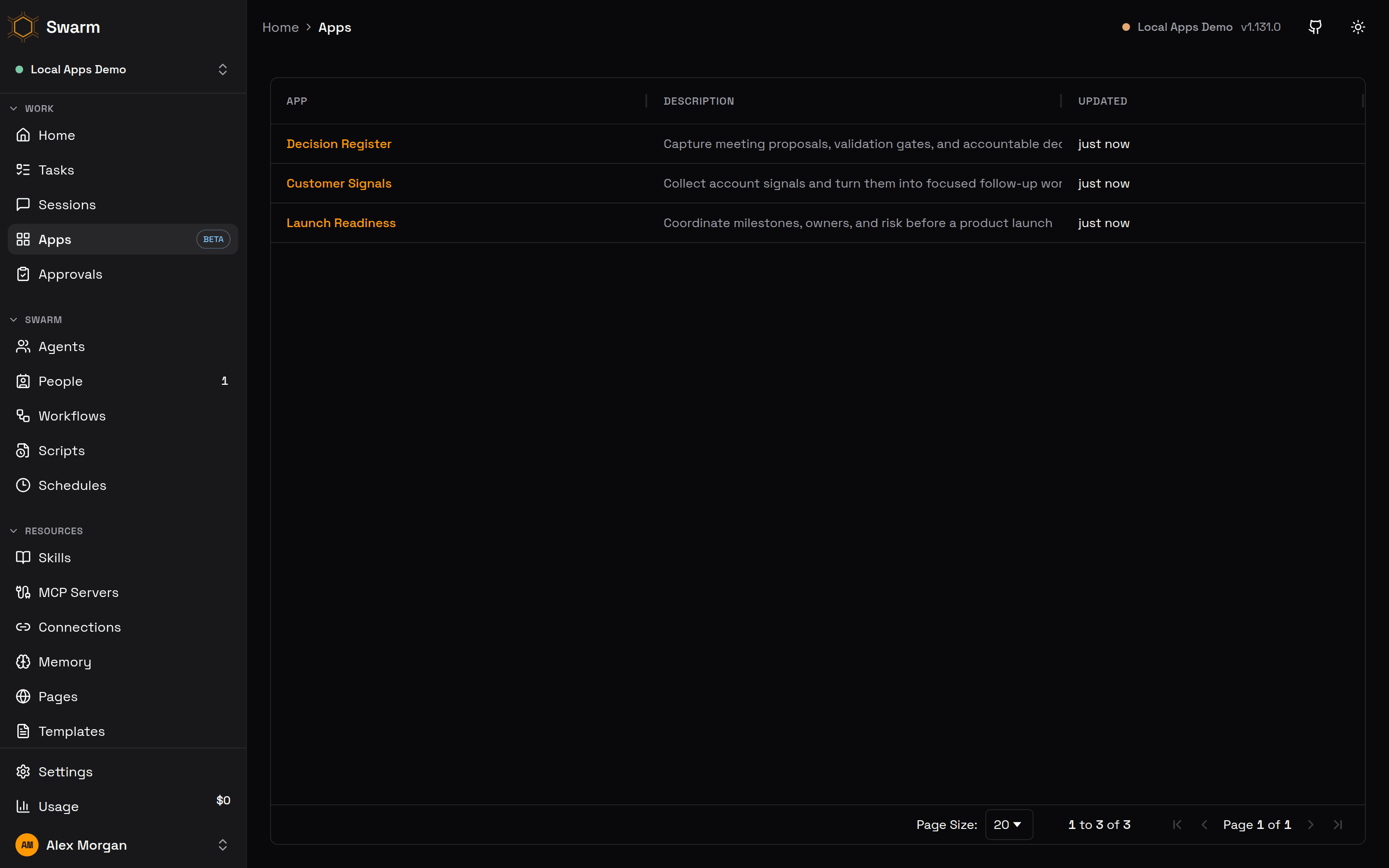
The Apps catalog gives every live App a stable dashboard route. The examples below use seeded sample data; they contain no customer records or credentials.
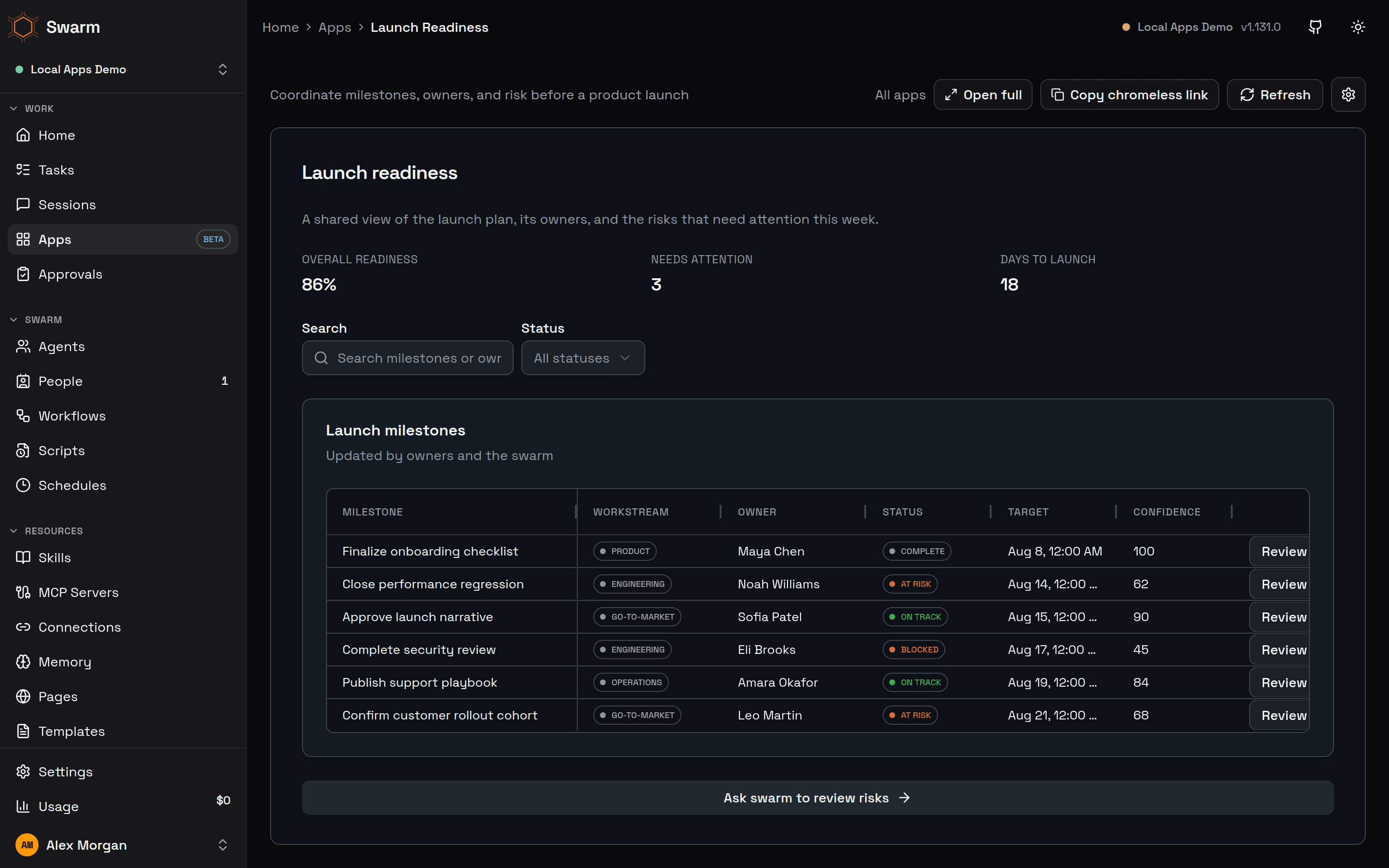
Each App renders its validated page definition against live named-query data. This Launch Readiness example combines metrics, filters, a populated table, and an action that can dispatch work to the swarm.
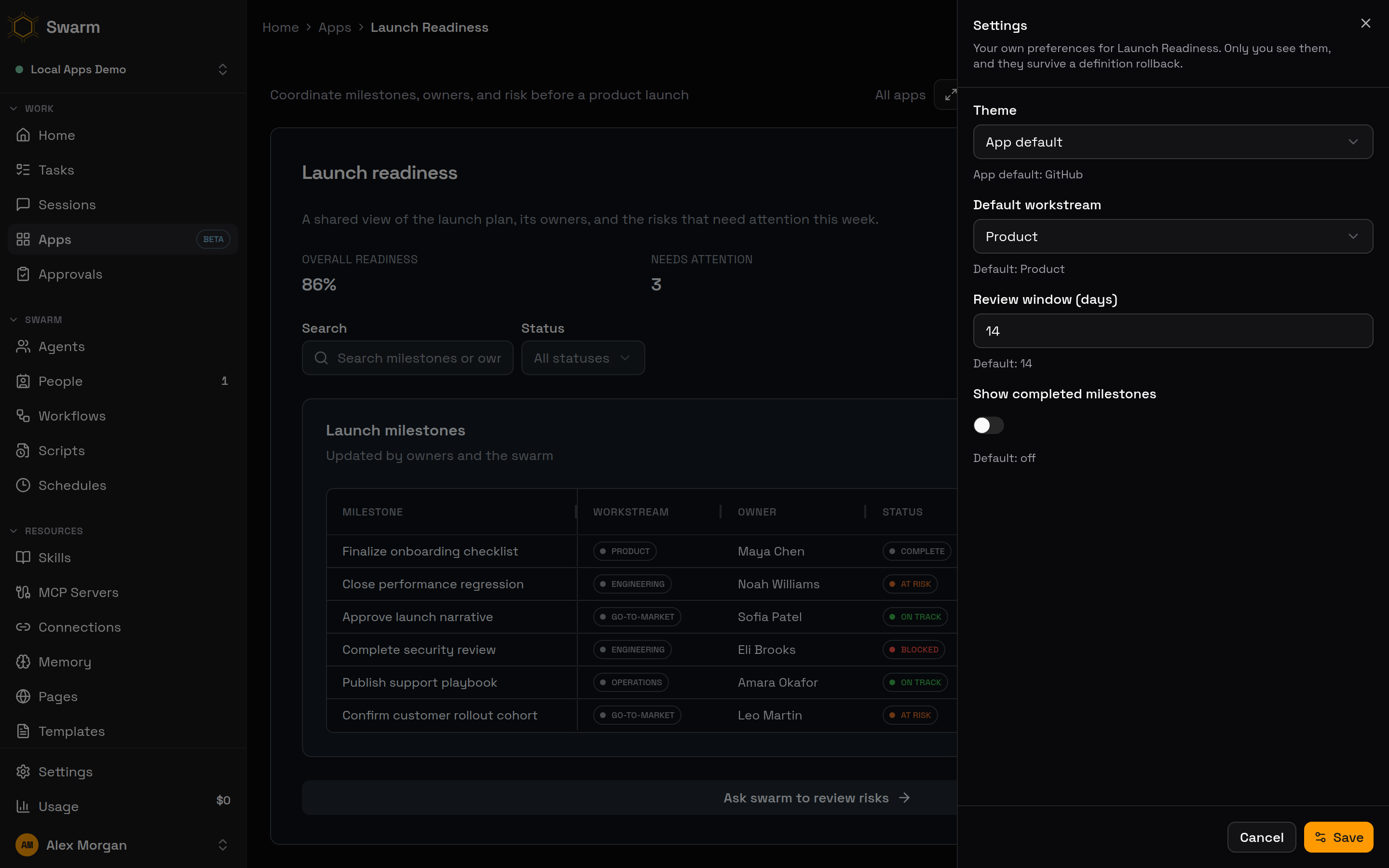
Per-user configuration stays outside the shared definition and rows. The settings drawer exposes those private values alongside the viewer's theme override.
Start here
- Understand the App primitives.
- Build and iterate on an App, including a complete example and messages you can send to the lead agent.
- Start from a worked recipe for a DB-only tracker, a Linear and GitHub delivery view, or gated meeting decisions.
- Open the Apps dashboard surface to use the result.
- Use the Apps API reference for lifecycle, row, query, sync, history, and user-config endpoints.
Deployment capability
App tools are available when the server's CAPABILITIES includes pages, for example CAPABILITIES=core,task-pool,pages. There is no separate apps capability flag.